


A merchant account is a business account at a bank (the acquiring bank) that receives your credit and debit card sales. When a customer pays by card, the money settles into your merchant account first, then moves to your regular business bank account, usually within one to two business days.
You need one to accept card payments, unless you use a service like Stripe, Square or PayPal that lets you share theirs. If you are ready to apply, open a merchant account with SeamlessChex. This guide explains how a merchant account works, how it differs from those services, the main types, what it costs and how to get one.
What Is a Merchant Account?
A merchant account is an agreement between your business and an acquiring bank that lets you accept card payments. The bank takes on the risk that your customers may later dispute a charge, so it reviews your business before it approves you. That review is called underwriting.
Each merchant account gets a merchant ID (MID), the number that identifies your business on every card transaction. A merchant account is not the same as a business checking account: you cannot pay bills from it. It is where card sales land before they are paid out to your business bank account.
How a Merchant Account Works
Every card sale follows the same path from the customer's card to your bank account, in four stages.
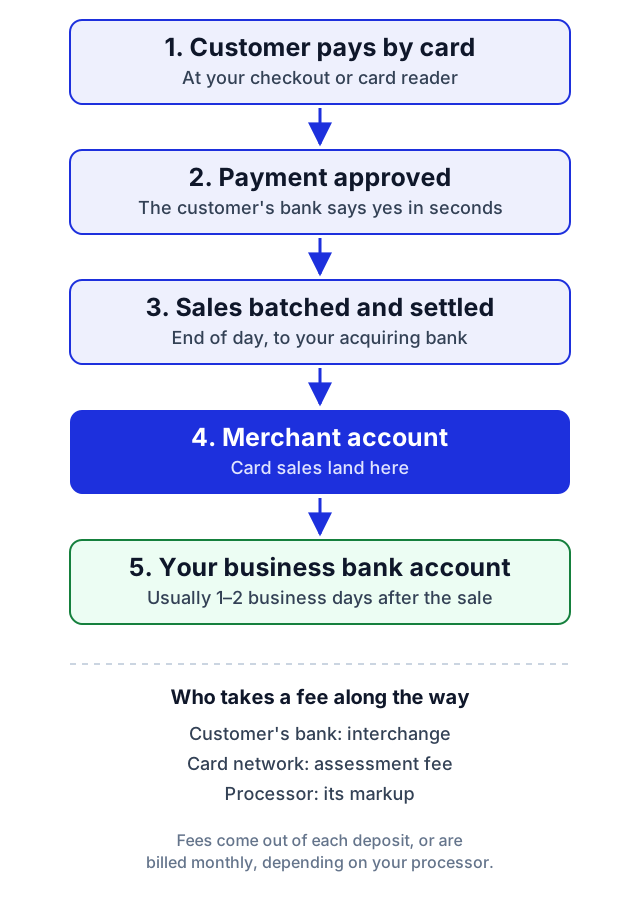
- Authorization: the customer pays, and the payment gateway sends the payment to the customer's bank, which approves or declines it in seconds. Approved funds are held on the customer's card.
- Batching: at the end of the day, your approved sales are sent together as one batch.
- Settlement: the customer's bank pays your acquiring bank through the card network, such as Visa or Mastercard.
- Funding: the money is deposited into your merchant account and then paid out to your business bank account. Fees are taken out of each deposit or billed monthly, depending on your processor.
Read more about the process in how a merchant account works for online businesses.
Merchant Account vs. Payment Service Provider (Stripe, Square, PayPal)
Payment service providers such as Stripe, Square and PayPal don't give you your own merchant account. They put many businesses under one shared account and let you start right away. The trade-off is that they review you after you start selling, and they can freeze or close your account if your sales look risky to them.
Types of Merchant Accounts
- Retail (card-present): for payments taken in person with a card reader or terminal. These carry the lowest risk and usually the lowest rates.
- Ecommerce (card-not-present): for online stores, plus phone and mail orders. Fraud risk is higher, so rates are a little higher too. See ecommerce payment processing.
- High-risk: for industries banks see as risky, such as nutraceuticals, CBD, online gaming, travel and subscription businesses, or businesses with high chargebacks. Expect closer underwriting and often a rolling reserve. See high-risk merchant accounts and what makes a merchant account high-risk.
- ACH and eCheck: bank payments don't use a card merchant account. They move straight between bank accounts through the ACH network, and usually cost less than cards. See ACH processing and eCheck processing.
Merchant Account Fees and Pricing
Most of the cost of a card payment goes to the customer's bank, not to your processor. Each sale carries three layers of fees:
- Interchange: paid to the customer's bank. It is the largest part and depends on the card type and how it was used.
- Assessment fees: paid to the card network, such as Visa or Mastercard.
- Processor markup: what your processor charges on top.
Processors package these three layers in a few ways:
- Interchange-plus: you pay the actual interchange and network fees plus a fixed markup. It is the most transparent model.
- Flat rate: one rate for every card, such as 2.9% plus 30 cents. Simple, but usually more expensive at higher volume.
- Tiered: sales are sorted into rate buckets the processor defines. It is the hardest model to compare.
Watch for other charges too: monthly or statement fees, PCI compliance fees, chargeback fees and early termination fees. High-risk accounts often have a rolling reserve, a share of each deposit (commonly 5–20%) held for a set period to cover chargebacks. See our guide to transaction fees for how each charge is calculated.
How to Get a Merchant Account
- Choose a provider that accepts your industry in writing and supports how you sell: in person, online or both.
- Gather your documents. Providers usually ask for your EIN, articles of incorporation, a copy of the owner's driver's license, a voided check, and three months of bank and processing statements if you have them.
- Apply and go through underwriting. The provider checks your business, website, refund policy and processing history.
- Get approved and connect. Link your merchant account to your card reader, online checkout or payment gateway integration, then run a test payment.
With SeamlessChex, standard accounts are typically approved the same day. High-risk accounts usually take 72 hours to a few business days. See the step-by-step guide to opening a merchant account in the USA, or apply for a SeamlessChex merchant account.
Do You Need a Merchant Account?
- You need one if you process a steady volume of card payments, want negotiated rates, or sell in a high-risk industry where Stripe, Square or PayPal may close your account.
- You may not need one yet if you take only a few card payments a month. A payment service provider is quicker to start with.
- Consider ACH or eCheck if your customers pay large invoices from a bank account. Bank payments cost less than cards and don't need a card merchant account.
SeamlessChex sets up merchant accounts for high-risk and hard-to-place businesses through more than 25 banking partners, with ACH and eCheck processing alongside cards.
Merchant Account FAQ
What is a merchant account in simple terms?
It is the account where your card sales land before they reach your business bank account. You need one, or a shared one through a service like Stripe or Square, to accept credit and debit cards.
Is a merchant account the same as a business bank account?
No. A merchant account only receives card sales from the acquiring bank. The money is then paid out to your business bank account, which you use to pay bills.
How much does a merchant account cost?
Most of the cost is interchange, paid to the customer's bank, plus card network fees and your processor's markup. Add any monthly, PCI compliance and chargeback fees. Compare quotes on interchange-plus pricing to see the processor's real markup.
How long does it take to get a merchant account?
Standard accounts can be approved the same day. High-risk accounts take longer, usually 72 hours to a few business days, because underwriting reviews the business more closely.
Do I need a merchant account to use Stripe, Square or PayPal?
No. They let you use their shared account instead. You get started faster, but your account can be frozen or closed if your sales look risky to them.
What is a merchant ID (MID)?
The number that identifies your merchant account on every card transaction. Your processor assigns it when your account is approved.
Can a high-risk business get a merchant account?
Yes, through a high-risk provider. Expect closer underwriting and often a rolling reserve. SeamlessChex approves high-risk businesses, including merchants on the TMF/MATCH list.